How to Handle Unexpected Child Expenses with Your Co-Parent
A divorced dad of 3 shares a system for handling surprise child expenses with your co-parent. Real scripts, real dollar amounts, what actually works.

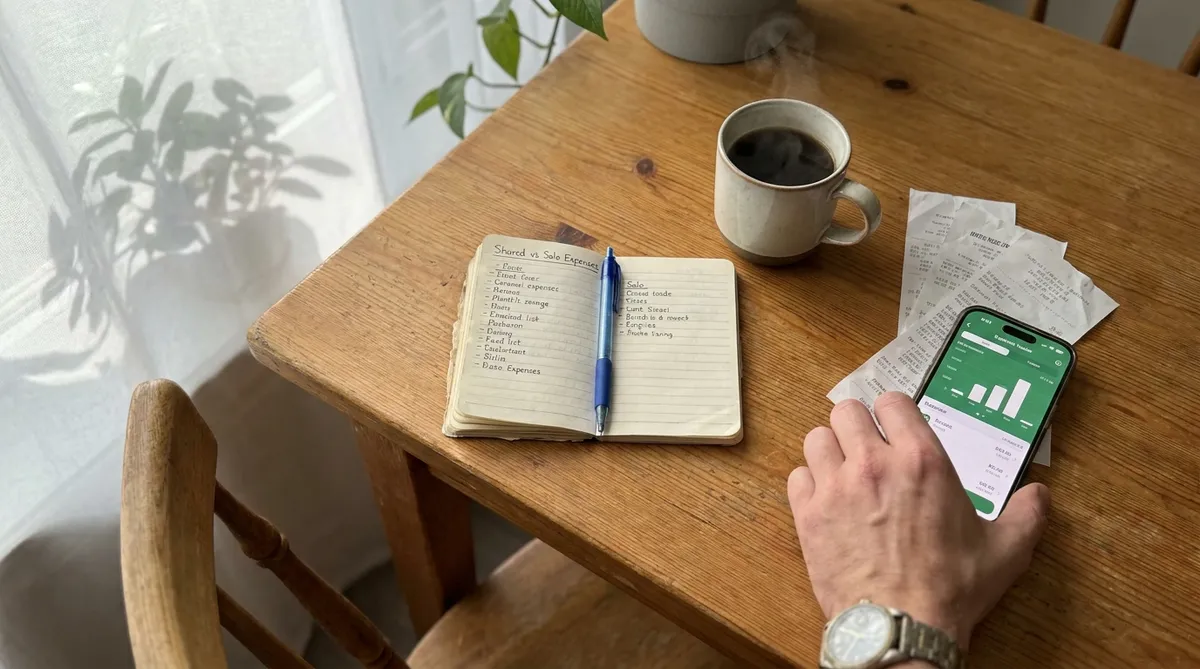
A photo. That's how it usually starts. My ex sends a phone snap of a $216 receipt from the urgent care clinic at 9:47pm on a Wednesday. My middle kid had an allergic reaction to a new soap at school. No "hey," no warmup. Just the photo. A year ago I would've stayed up half the night drafting the perfect reply. Now I open the tracker, log it, send a one-line acknowledgment, and go back to bed.
Surprise child expenses are the single biggest reason co-parents fight about money. Not the ongoing support payment, not the rent. The $80 broken glasses. The $216 walk-in clinic visit. The $460 summer camp deposit that's "due Friday or your kid loses the spot." Those are the bills that turn an ordinary Tuesday into a 3-day argument.
I'm a single dad of three (ages 5, 9, and 11) in Montreal. My ex and I have been splitting expenses since we separated in 2023. Here's the actual system I use to keep surprise bills from blowing up our co-parenting, what I've gotten wrong along the way, and what I'd tell any divorced parent on day one.

What counts as an unexpected child expense?
An unexpected child expense is any cost for your kid that wasn't part of the agreed monthly budget and wasn't pre-approved with your co-parent. The usual suspects: emergency medical visits, last-minute school trips, broken items, sudden equipment fees for a new sport, and "due tomorrow" registration deposits. They share one trait: zero room to plan.
The reason these matter is that they don't fit the regular pattern. Daycare invoices land the same day every month. School fees show up on a schedule. But when your daughter walks in the door with a permission slip for a $95 ski trip due in 48 hours, that's a different category of expense. It needs a different process.
For context, here's the rough breakdown of what hit my household across the first nine months of 2025, just for the unexpected stuff:
- Replacement winter boots after one pair "vanished" at school: $90
- Soccer cleats after my middle kid grew two sizes in four months: $75
- Walk-in clinic copay plus prescription for strep: $140
- Broken iPad screen after a sleepover at a friend's: $220
- Field trip to the Montreal Biodome: $45
- Emergency vet visit for the kids' guinea pig: $180
- Goalie equipment my oldest "had to have" for a tournament: $310
That's $1,060 in nine months on items nobody could have planned. Multiply by three kids and you start to see why "we'll figure it out as it comes" is the worst possible system.
Why do surprise expenses cause the worst co-parenting fights?
Surprise bills hit three nerves at once: cash flow stress, the loss of control over a shared budget, and the unspoken question of whether the purchase was even necessary. When my ex sees a $130 judo bill she didn't approve, she isn't really arguing about her $65 share. She's arguing about being told after the fact.
I learned this the hard way. My oldest had been asking to do judo for almost a year. I finally signed him up at $130 a month and figured I'd just tell my ex once the first bill cleared. Big mistake. She said she wouldn't pay for something she didn't agree to. I covered the full amount myself for three months while we negotiated. Then he got injured at practice, and she said she wouldn't contribute to any extracurricular going forward. The fight was about me making a budget decision without her in the room. Money was just the surface.
Most "unexpected" expenses aren't actually unexpected to one of the parents. Either she saw the school newsletter, or I booked the appointment without flagging it first. The shock part comes from how the news gets delivered, usually a screenshot of a receipt at 9pm with no warmup. That's why the system you use to surface these costs matters more than the dollar amount on the receipt.
How should you tell your co-parent about a surprise bill?
The cleanest approach is to log the expense in a shared tracker first, then send a short factual message. Never lead with a photo of a receipt and a dollar figure. A neutral message includes what it was for, the amount, the date, and (if needed) why it couldn't wait. Skip the explanation of why it's "fair." That's where fights start.
Here's the script I use now. It works about 80% of the time:
"Hey, quick FYI. [Kid's name] needed [thing] today, came to $[amount]. Logged it in the tracker with the receipt. No rush on your half."
Three things this script does:
- "FYI" signals it's information, not a demand.
- "Logged it in the tracker" means there's a paper trail. They can verify, dispute, or pay whenever.
- "No rush" removes the urgency that triggers defensive responses.
What I used to do, and what I still see other co-parents doing, is sending a photo of the receipt with "you owe me $X." That phrasing puts the other parent in defense mode before they've even read what the expense was. It also forces an immediate response, which guarantees an emotional one.
If your co-parent is the type who needs to approve every purchase before it happens (mine sometimes is), I learned to flag potential expenses on the same day they come up: "Heads up, school sent a $45 field trip slip due Friday. I'll cover it upfront and we can split after." That tiny shift, sending the message before the spend, eliminates roughly 90% of the "you should've asked me first" arguments.
For deeper scripts on harder conversations, I wrote a separate post on what to do when your co-parent won't split expenses.
What if your co-parent refuses to pay their share?
If your co-parent flat refuses to split a legitimate child expense, your first move isn't legal action. It's documentation. Save the receipt, the doctor's note or school slip, and every text related to the discussion. Most U.S. states and Canadian provinces treat necessary medical, educational, and basic-needs costs as shared by default, regardless of who initiated the purchase.
This happened to me with my son's dentist visit after his judo injury. My ex said she wouldn't contribute because the injury "wouldn't have happened if you hadn't signed him up for judo." A year ago I would've spiraled, paid it all, resented her for six months, and brought it up at the next handoff. Instead I logged the expense, attached the dentist's invoice, and sent one line: "Recording this for the file. We can talk about it when you're ready."
She paid her half three weeks later. I think she just needed the time to not feel cornered.
That said, sometimes a co-parent refuses on principle. For necessary medical care this gets complicated fast and varies by jurisdiction. The U.S. Department of Health and Human Services Office of Child Support Services has resources on enforcing medical support orders, and most family courts treat unreimbursed medical bills as shared 50/50 (or proportional to income) unless your custody order says otherwise. If you're regularly hitting walls on medical bills, my deeper guide on when your co-parent won't split medical expenses and what your rights are walks through the legal options.
For non-medical surprises (extracurriculars, optional trips, electronics), the answer is murkier. My honest take: don't go to court over a $200 disagreement. The legal fees will cost more than the bill itself. Build a written list instead of what counts as "shared" and what counts as "your call, your wallet." We did this six months in. It cut our fights roughly in half.
How can you build a small buffer fund for the unexpected stuff?
The cleanest fix is a small joint buffer fund, typically $200 to $500 per parent, refilled quarterly, earmarked specifically for unbudgeted kid costs. It removes the "who pays first" friction because the money is already pooled, and it cuts the emotional weight of getting hit with a $300 bill on a Tuesday.
We tried this in late 2024 and it was the single biggest thing that reduced our money fights. Each of us put $300 into a shared sub-account at our credit union (Desjardins, here in Quebec; any joint savings account works). The rules: only kid expenses, only over $50, both of us can pull from it, and we top it back up to $300 each on the 1st of every quarter.
It isn't a perfect system. Twice we drained it in six weeks (winter coats plus a strep epidemic at school). Once she pulled $200 for soccer registration without telling me first, which annoyed me, but I let it go because the fund existed for exactly that. Perfection isn't the point. The point is that there's a pre-agreed pool of money that doesn't require a fresh negotiation every time something breaks.
If a joint account feels like too much (some co-parents won't go there for control reasons), each of you can keep your own "kid emergency" envelope of $200 to $400. You still log every withdrawal in your shared tracker so the math comes out even at month-end. Less ideal, since you each float your own cash, but it removes the bank-access friction.
What's the easiest way to actually track these expenses?
The easiest system is a shared digital tracker that timestamps every expense, attaches a receipt photo, and auto-calculates who owes what at month-end. The reason this beats a Google Sheet or WhatsApp threads is consistency: when both parents see the same running balance, the "did you forget about that one?" arguments disappear.
I tried Google Sheets first. Lasted four months. The issue isn't the tool. Sheets is fine. Where it falls apart is human behavior. My ex would forget to log her purchases for two weeks, then dump nine entries at once, half of them with no receipt. I'd nag, she'd get defensive, we'd fight, nothing got logged for another week. Spreadsheets work only if both parents are equally meticulous. In two years of co-parenting, I've never met a divorced couple where both people are equally meticulous about anything.
I also looked at OurFamilyWizard. The features are solid (court-ready reports, messaging, expense logs), but at $300 per year per parent, it was $600 a year just to track who bought my daughter's snow pants. I couldn't justify it. My ex straight-up refused to install it ("looks like a divorce-court app").
That's part of why I built CoParentSplit. I needed something my ex would actually use. Simple enough that adding an expense takes 15 seconds, cheap enough that nobody's mad about the cost ($6.99/month or $59.99/year covers both parents), and clear enough that the running balance is always visible to both of us. Once I started logging every single expense, even the $12 ones I used to eat, I realized I'd been quietly paying about $180 more per month than my actual "half." Two years of that adds up.
If you want to play with the math without signing up for anything, I built a free expense calculator that does the proportional split based on each parent's income. It's the same logic most family courts use.
Ready to simplify co-parent expenses?
CoParentSplit makes it easy to track, split, and settle shared child expenses — no conflict required.
Start Free NowHow do you handle the really big surprise expenses?
For expenses over roughly $500 (orthodontics, surgery, a stolen laptop, a major dental procedure), the rules change. Skip the casual text. Schedule a 15-minute call or video chat, even if you and your co-parent normally communicate by message only. Big amounts deserve a real conversation, not a screenshot.
Here's how I framed it the time my middle kid needed $2,800 of dental work over six months:
- Sent a calendar invite for a 20-minute call with a one-line agenda: "Dr. Patel quoted $2,800 for [kid]'s dental work. Want to figure out how we handle it."
- Brought three options to the call: split 50/50 over six months, split proportional to income (60/40 in our case), or one of us pays upfront and the other reimburses by tax-refund time.
- Wrote down whatever we agreed, then sent it as a confirming text within 30 minutes.
That last step matters. Anything verbal vanishes. A confirming text ("to recap, we agreed I pay the dentist directly and you transfer me $1,400 by July 15") becomes the official record if there's ever a disagreement later. I save those in a folder labeled "kid-money-agreements" and back it up to my Google Drive every few months.
For deep dives on specific expense categories that tend to surprise new co-parents, see my breakdown of extracurricular costs after divorce and who pays what. Sports and music lessons are the #1 source of "I didn't agree to that" arguments I get in my Reddit DMs.

What would I tell any divorced parent dealing with this?
Two years in, here's what I wish someone had told me on day one of co-parenting:
- Log everything the same day. Not the next morning, and definitely not "when I get home." Memory is the enemy.
- Never discuss money during kid handoffs. Children hear everything. Save it for after-hours messages or scheduled calls.
- Don't argue about anything under $20. Your peace is worth more than $10 of reimbursement. Just eat the small stuff.
- Build the system before you need it. The worst time to negotiate "how do we handle surprise medical bills" is after a $400 bill has already shown up.
- Document everything in writing. Even the small wins. Especially the small wins.
The thing about unexpected child expenses is that they're not actually unexpected. They're inevitable. Your kid is going to need new glasses. Eventually they'll break something. Sooner or later they'll come home with a permission slip due tomorrow. The only real question is whether you have a system that handles those moments without setting your week on fire.
Stop fighting about money. Start tracking it. Try CoParentSplit free for 30 days, no credit card, both parents free, and the math is always visible to both of you so the surprise becomes a logistics problem instead of an emotional landmine.
Related: How to Split Child Expenses After Divorce · Co-Parenting Expense Categories Guide
Ready to simplify co-parent expenses?
CoParentSplit makes it easy to track, split, and settle shared child expenses — no conflict required.
Start Free Now
Founder of CoParentSplit
Single dad of 3, product manager, and immigrant in Montreal. Built CoParentSplit after his own divorce because he needed a simpler way to split child expenses with his co-parent.