How to Ask Your Co-Parent for Money Back (Messages That Don't Start a Fight)
Copy-paste messages to ask your co-parent for reimbursement: monthly totals, medical bills, unagreed costs, reminders, and when to switch to a formal request.

To ask your co-parent for money back without starting a fight, ask once, in writing, and answer every question before it comes up: what the expense was, which child it was for, the receipt, the total, their share and the date you'd like the money by. Leave out how you feel about it and anything that happened last time. A request that leaves nothing to check leaves much less to argue about.
Before we had any system, my ex and I sent receipts over WhatsApp and reminded each other by message who owed what, until it turned into an argument. Every purchase had to be proven with a receipt, then I had to remind her of the amount, then explain what it was for. The templates below fold all of that into the first message.
I'm a Montreal dad of three kids, not a lawyer. The rules quoted here come from official pages for Florida, California, Minnesota and Canada, and your own order or agreement comes first.
What every request should contain
Florida's Child Support Program says a parent who paid uncovered medical costs must ask the other parent in writing, and, when the order gives no instructions, lists 8 items for that request. Alberta's public legal education centre (CPLEA) has a similar 5-point list for Canadian special expenses. Put together, they make a checklist that works for any shared cost, court order or not:
- The child's name.
- What it was, where, and when. Provider or store, type of service or item, date.
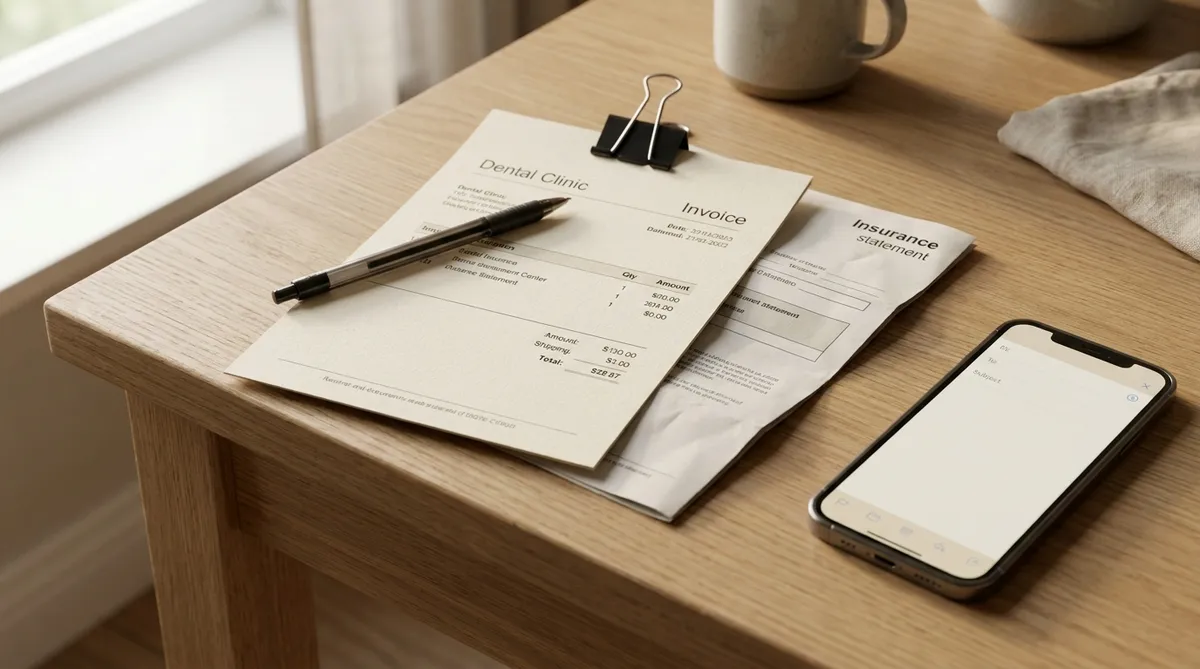
- What you paid, with proof. Receipt, invoice, insurance statement, sign-up form or quote.
- Their share, and how you got it. "Half per our agreement" or "my 2/3, your 1/3 per our order."
- The date you'd like it by.
- Today's date, so there's a record of when you asked.
CPLEA adds one formatting rule worth stealing: one paragraph per expense.
What to leave out matters as much. The High Conflict Institute's BIFF method (Brief, Informative, Friendly, Firm) says a long reply "gives a high-conflict person more to react to." TalkingParents adds the "three A's" to avoid: admonishments, advice and apologies (an apology can invite the other parent to blame you). So no "sorry to bring this up again," no "you always," no history.
Pick a deadline and say it
A request without a date is a suggestion. Where the order is silent, some places set a default, but there is no universal legal deadline, and the starting point differs:
| Where | Default when the order sets no timeframe | Counted from | Source |
|---|---|---|---|
| Florida | You may give the other parent 30 days | The date they receive your written request | Florida Department of Revenue |
| California | The other parent pays within 30 days (or per a provider, agreed written or court schedule) | Notice of the amount due | Judicial Council form FL-192 |
| Minnesota | 30 days to respond to a Notice of Intent to Collect | The notice | Minnesota DCYF |
| No court order, informal agreement | Nothing set by these rules | Whatever you both accept | Your agreement |
With no order, borrow 30 days as your house rule: long enough to be fair, short enough that nobody forgets. For anything with a registration date (camp, a season of a sport), CPLEA's sample ties the answer deadline to that date instead.
The messages
Fill in the brackets.
The monthly total
Small recurring things (clothes, school supplies, a pharmacy run) are where requests turn into nagging. Send one message a month instead of one per receipt.
Hi, here are the kids' expenses I paid in [month]: [item, date, amount, one per line]. Receipts attached. Total [$total], your share [$share] per our 50/50. Could you send it by [date]? Thanks.
A single expense you both agreed to
A family law firm's sample is one line (the amount, "your half," receipt attached, "Thanks") under a subject naming the expense and date. That's enough for something already agreed.
Subject: [Activity] registration, [month]
Please reimburse [$share], your half of the registration fee (receipt attached). Thanks.
A surprise medical or dental bill
Use every item from the checklist here, because these are the bills official rules care about. California's form FL-192 says you must give the other parent an itemized statement within a reasonable time and no more than 90 days after you got the bill, and that if you paid the full cost you must include proof of payment. Under the Federal Child Support Guidelines, a child's health costs above what insurance pays back count as section 7 special expenses once they pass $100 a year.
[Child] saw [provider] on [date of service] for [type of service]. Insurance covered [$], I paid the remaining [$total]; receipt and insurance statement attached. Your share is [$share]. Could you pay by [date]? Sent [today's date].
Before you buy: asking for a yes
CPLEA says you "can avoid a lot of conflict" by asking for consent to a special expense ahead of time. Its sample request is a $350 math tutor split 2/3–1/3, the way those parents usually share special expenses ($350 × 2/3 = $233.33, rounded to $233; $350 − $233 = $117), ending with a yes/no question and a deadline. Copy that shape:
[Child] would like to start [activity] on [date]. It costs [$amount] for [period]; sign-up form attached. Split [our usual way], your part would be [$share]. Are you in? Registration closes [date], so could you let me know by [date]?
An expense they never agreed to
Here, be careful about what you claim. An unagreed cost is something to negotiate, and in Canada a special expense has to be necessary for the child and reasonable given the family's means. So ask instead of billing:
I paid [$total] for [item] for [child] on [date], receipt attached. I know we didn't agree on it first. Would you be willing to cover [$share]? If not, I'll count it as mine, and I'll check with you before the next one.
The last sentence is the "Firm" part of BIFF: it closes the topic either way. If this keeps happening, do what OurFamilyWizard recommends and write down how each type of cost is handled and by whom.
Replies to the usual pushback
Restate the fact, the amount and the date, and leave everything else unanswered, as TalkingParents' sample reply to a hostile field-trip refusal does.
- "Show me the receipt." Send it again, with no comment: "Attached again. [$share] by [date] works."
- "I never agreed to that." If they did, point to when: "We agreed on [date] by text; screenshot attached." If they didn't, use the unagreed-expense message above.
- "You earn more, you pay." Point to the share in your order or agreement, not to fairness: "Our [order/agreement] splits [category] [ratio]. Your share is [$share]."
- Insults with nothing practical in them. TalkingParents' advice is that the best reply is none.
The second and third reminder
The second reminder is the first one, shorter, with a new date:
Following up on [expense] from [date]: [$share] is still open. Receipt attached again. Could you send it by [date]?
If that goes unpaid too, the third message is a formal written request by email, with every checklist item, the receipt and copies of your earlier messages. Keep copies: Florida's Child Support Program needs that correspondence if asked to help collect, and the law firm above notes an emailed request plus receipt becomes your evidence for a later contempt motion.
The one you don't send
Some amounts aren't worth a message. My own rule: don't argue over anything under $20, the nerves cost more. Put it on the monthly list if you like, and if it gets disputed, drop it.
When to stop messaging
The escalation path is the same idea at each step: more formal, same facts.
- Message, as above.
- Formal written request by email, as in the third reminder.
- Agency or court. California's form says to talk it through first; if that fails, either parent can ask the court to decide. In Minnesota (after the 30-day notice above) and Florida, the child support office can be asked to help, or you can file a motion.
These routes assume a support order. With only an informal 50/50, start with our guide for a co-parent who refuses to share costs.
Ready to simplify co-parent expenses?
CoParentSplit makes it easy to track, split, and settle shared child expenses — no conflict required.
Start Free NowFrequently asked questions
How long do I have to ask my co-parent to reimburse a medical bill? It depends on your order and where you live. California allows no more than 90 days after you receive the bill; Minnesota, two years from the expense. Elsewhere, check your order, and ask within weeks rather than months.
Should I ask my co-parent for reimbursement by text or by email? Both count as writing, which is what matters. Text suits a routine monthly total. For larger amounts or anything disputed, use email: name the expense and its date in the subject line, attach the receipt and keep a copy. Email also keeps the receipt and the request together in one thread.
Can my co-parent refuse to pay until a court decides? In California, not quite. Under form FL-192, a parent who disputes a reimbursement request may ask the court to resolve it only after paying the requested amount. Courts presume paid uninsured health care costs were reasonable and can order an unreasonable parent to pay the other's attorney's fees. Other states and provinces set their own rules.
Does my co-parent have to pay exactly half of every expense? Only if your order or agreement says so. In Canada, the guiding principle for section 7 special expenses is that they are shared in proportion to the parents' incomes, after any contribution from the child. Your order may set a different percentage. Use the share your order states and show how you calculated it.

Send requests from a shared record
Requests are easiest when they point to a log you both see. Log expenses the same day, while the receipt is still in your pocket. If you don't have one yet, here's how to start a shared expense log, even if the other parent won't join at first. When your split isn't 50/50, the free expense split calculator works out each share so you can quote the number. And keep all of this away from the handoff: OurFamilyWizard advises not talking about expenses or reimbursement in front of the child, and the kids hear everything.
CoParentSplit's expense tracker keeps the log, receipt photos and a running balance in one place, and its monthly settlement records partial payments with notes. The free tier needs no card and covers 1 child and up to 10 expenses a month. Premium is included for your first 14 days. After that, one subscription covers you both (the second parent joins free) at $59.99 a year, or $6.99 if you pay monthly.
Ready to simplify co-parent expenses?
CoParentSplit makes it easy to track, split, and settle shared child expenses — no conflict required.
Start Free Now
Founder of CoParentSplit
Single dad of 3, product manager, and immigrant in Montreal. Built CoParentSplit after his own divorce because he needed a simpler way to split child expenses with his co-parent.